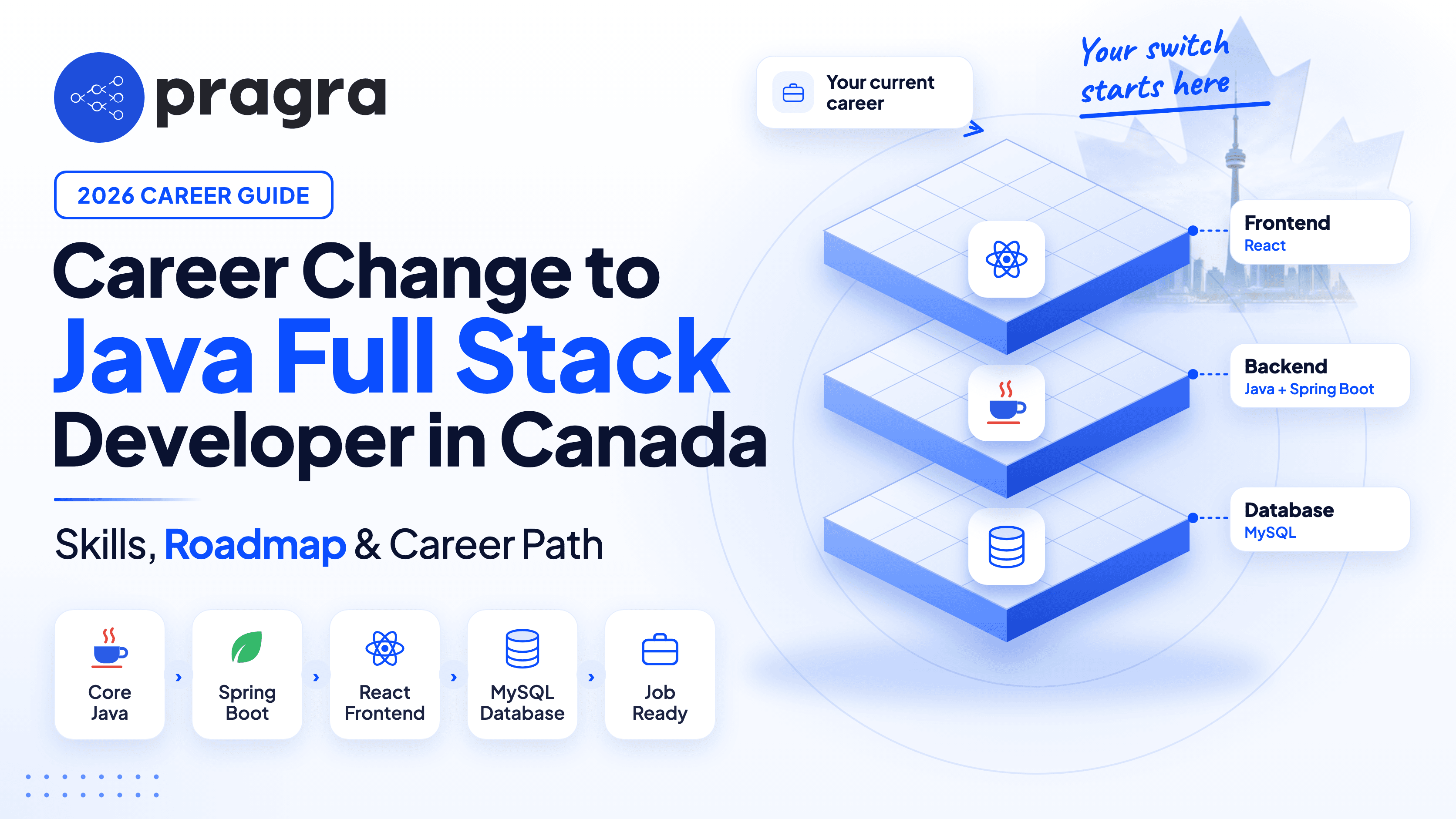
Non-IT to IT in Canada: A Career Changer's Guide to Java Full Stack Development
Yes, you can move from a non-IT job into a Java full stack developer role in Canada, and plenty of people do it in their 30s and 40s. But it is not a 12-week switch. For most career changers it takes a year or more of steady work, a portfolio that proves you can build, and a job search aimed at the right employers.
This guide helps you decide whether Java full stack fits your background, then shows the route that gives a career changer the best odds. If you have already decided on Java and just want the skills list, read our step-by-step guide to becoming a full stack Java developer in Canada. This article answers the earlier question: is this the right move for someone like me?
Is switching from non-IT to IT still worth it in 2026?
Yes, if you go in with clear expectations. The pay is real: Job Bank puts the national median wage for software developers at $48.08 an hour, with the high end at $76.92 (2023–2024 data, updated November 2025). On a 37.5-hour week, that median works out to roughly $94,000 a year.
The entry-level market is also tougher than it was in 2021 and 2022. You compete with computer science graduates, other bootcamp graduates and experienced developers who were laid off.
It is worth it if you enjoy solving fiddly problems, can commit 10–15 hours a week for a year, and can live with a slower start. It is probably not worth it if you want a pay jump within three months, or you hate sitting with a broken program until it works.
Why Java full stack suits career changers
Java and its main framework, Spring Boot, run the core systems of banks, insurers, telecoms, government departments and large retailers. Those are the same industries many career changers come from. That gives you something a 22-year-old graduate does not have: you already understand the business the code serves.
- Your domain knowledge counts. A former claims adjuster knows how a claim moves through approvals. A former bank teller knows why a transaction must never post twice. Enterprise Java teams spend much of their time turning rules like these into code.
- Java's strictness helps on real teams. Java checks data types before a program runs, so many mistakes are caught early. It feels slower in your first week, but it makes large codebases easier to work in, and large codebases are what employers have.
- The skills last. Java releases a new version every six months, with long-term-support versions every two years, and enterprise systems built on it stay in service for decades. You are not betting on a framework that may vanish next year.
Full stack means you also learn a frontend, usually React, so you can build a complete application on your own. If you are torn between Java and the JavaScript-only MERN stack, the comparison table on our Java Full Stack Developer course page shows who each path suits.
Which non-IT backgrounds transfer best to Java roles?
Almost every background transfers something. These six transfer the most because their industries run heavily on Java.
| Your background | What transfers | Where to aim first |
|---|---|---|
| Banking, credit union or accounting | Transaction rules, reconciliation, compliance | Payments, lending and core banking teams |
| Insurance (claims, underwriting, brokerage) | Policy and claims workflows, risk rules | Insurance platform and claims-system teams |
| Telecom or call centre | Billing logic, troubleshooting with customers | Billing and CRM systems, support-to-developer paths |
| Retail, logistics or supply chain | Inventory, order and fulfilment flows | E-commerce, order and warehouse management backends |
| Healthcare administration | Scheduling, records, privacy rules | Health IT and patient-system vendors |
| Engineering, science or skilled trades | Systematic problem solving, reading specifications | Backend services, integrations, industrial software |
Teachers, salespeople and hospitality workers are not on this list because their industries use less Java, not because their experience lacks value. Communication and working with people matter on every development team, so make those strengths visible in interviews.
Age, degree and Canadian experience: the three big worries
Is 30, 35 or 40 too old to become a Java developer?
No. There is no age cut-off in software development, and people who switched careers in their 30s and 40s work on development teams across Canada. The real constraints are time and money, not age. If you have rent, a mortgage or children, plan a part-time route instead of quitting first.
Interviewers judge what you can build and how you work with others, and your years in the workforce help with the second part.
Do you need a computer science degree?
It helps, but it is not always required. WorkBC notes that most jobs ask for a diploma or degree in computer science or a related field. Many postings, however, add "or equivalent experience", and that phrase is your way in. Equivalent experience means a portfolio of working projects, clean code on GitHub, and the ability to explain your decisions in a technical interview. Some large employers and government roles filter strictly on degrees, so focus on postings that include the "or equivalent" wording.
Newcomers: how to handle the "Canadian experience" problem
If you are new to Canada, you may hit the "no Canadian experience" wall even with a degree from home. Three things help:
- Build projects that solve Canadian problems, such as a GST/HST invoice tool or a transit-schedule app built on a Canadian city's open data.
- Volunteer or freelance for a local non-profit or small business so you have a Canadian reference.
- Go to local tech meetups and Java user groups, where you meet the people who hire.
If you worked in IT back home and drifted into non-IT work after moving, say so plainly on your résumé. You are restarting, not starting from zero.
How long does it take to switch from non-IT to Java developer?
Plan on 9 to 15 months from your first line of code to your first offer if you study part-time, about 10–15 hours a week. Studying full-time shortens the learning phase, not the job search.
| Phase | What you learn or do | Part-time duration |
|---|---|---|
| 1. Foundations | Core Java, object-oriented programming, Git, basic SQL | 2–3 months |
| 2. Backend | Spring Boot, REST APIs, databases, testing | 2–3 months |
| 3. Full stack | React frontend, connecting it to your API, deploying with Docker | 2–3 months |
| 4. Portfolio and job search | Two or three polished projects, résumé, interviews | 3–6 months |
Can you learn full stack in three months? You can cover the topics in three months of full-time study. Being hireable takes longer, because employers want to see you build without step-by-step instructions, and that only comes from repetition on your own projects.
Is Java hard to learn for beginners?
Java is harder to start than Python and easier to grow with. Your first programs need more lines, and the compiler is strict about data types. That strictness is also what makes Java easier on large team projects, which is the work Java jobs involve.
Choose Python if you want data analysis or machine learning. Choose Java if you want backend or full stack roles at banks, insurers, telecoms or large enterprises. Do not learn both at the start; pick the language that matches the jobs you want.
Is Java outdated? No. It is actively developed, runs on every major cloud platform, and Spring Boot remains a default choice for enterprise backends. Old is not the same as outdated: the long life of Java systems is the reason the jobs keep coming.
A 6-step plan for career changers
- Test before you commit. Spend two to four weeks on free Java basics. If you enjoy the moment a broken program finally runs, keep going. If you dread it, you have saved yourself a year.
- Choose your structure. Self-study is cheapest and works if you are disciplined. A structured program adds a schedule, feedback on your code and career support. Most career changers who give up do so because they stall alone, not because the material is too hard.
- Build projects from your old industry. A former bank employee who builds a loan-repayment tracker with Spring Boot and React has a stronger interview story than someone with a to-do list app. Interviewers remember projects that solve a real business problem.
- Rewrite your résumé as a hybrid. Lead with your technical skills and projects, then present your previous career as domain expertise, not a gap. "Five years in insurance claims" is a selling point for an insurance tech team.
- Aim at bridge employers first. Apply to companies in your former industry, check your current employer's internal job board, and consider QA or application support roles. WorkBC notes that many developers begin as junior developers or in quality assurance.
- Prepare for the Canadian interview process. Expect a screening call, a coding exercise on basic data structures and algorithms, Spring Boot and SQL questions, and a behavioural round. Practise explaining your projects out loud.
Mistakes that slow career changers down
- Staying in tutorial mode. Watching courses feels like progress. Building something without a guide is what builds skill.
- Learning five stacks at once. Java, Python, JavaScript, cloud and AI in the same month leaves you shallow in all of them. Go deep on one stack first.
- Quitting your job too early. Keep your income until you have finished at least one real project and confirmed you enjoy the work.
- Collecting certificates instead of projects. Employers look at your GitHub before your certificates.
- Hiding your previous career. Your past job is evidence that you show up, communicate and understand a business. Use it.
Self-study or a structured Java full stack program?
Both can work. The difference is how you handle being stuck.
Self-study suits people who are disciplined, can find answers on their own and do not need deadlines. A structured program suits career changers who want a fixed schedule, someone to review their code, and help with résumés and interviews. Whichever you choose, check that it covers Spring Boot and React rather than only core Java, ends with a capstone project you build yourself, and includes interview preparation.
Pragra's Java Full Stack Developer course is a live, instructor-led online program for learners in Canada and the US. It runs from Core Java through Spring Boot, microservices, React, Docker and Kubernetes. The bootcamp format adds a dedicated mentor and career support, and every learner finishes with a full-stack capstone to show employers.
The bottom line
Moving from non-IT to IT in Canada is realistic, not quick. Java full stack is a strong fit if you come from banking, insurance, telecom, retail, healthcare or engineering, because those industries run on Java. Give yourself a year, build projects that connect your old career to your new skills, and aim your search at employers who value both.
Not sure Java is your path? Book a free consultation with a Pragra advisor to match your background to the right program, or compare six realistic options in our tech career change guide.
Frequently asked questions
How do I switch from a non-IT job to IT in Canada?
Pick one target role first, such as Java full stack developer, instead of learning everything. Test your interest with a few weeks of free basics, then follow a structured plan, build two or three projects linked to your previous industry, and aim your job search at employers in that industry. Expect the full switch to take about a year part-time.
Is it worth getting into IT in 2026?
It is worth it for people who enjoy problem solving and can commit about a year to learning. Software developers in Canada earn a national median of $48.08 an hour according to Job Bank. The entry-level market is competitive, though, so you need a strong project portfolio, not just a certificate.
Is 30 too old to start coding?
No. Many developers in Canada started in their 30s or 40s. Employers hire for skills, and career changers bring workplace habits, communication and industry knowledge that new graduates lack. The bigger challenge is fitting study around work and family, so most people over 30 do best with a part-time plan.
Can I become a Java developer without a degree?
Yes, though it is harder. Most postings prefer a computer science degree, but many add "or equivalent experience". You meet that bar with a portfolio of working Java and Spring Boot projects on GitHub and by explaining your code confidently in interviews. Some large employers and government roles still filter strictly on degrees.
Is Java still in demand in Canada in 2026?
Yes. Java and Spring Boot run core systems at Canadian banks, insurers, telecoms, retailers and government departments, and these systems stay in service for many years. Java also releases a new version every six months, so the language keeps evolving. Demand is strongest for developers who combine Java with Spring Boot, cloud and containers.
Is Java harder to learn than Python?
Java is harder to start because it needs more code and is strict about data types. That strictness catches mistakes early and makes large team projects easier to manage. Choose Python for data or machine learning work, and Java for backend and full stack roles in enterprise companies.
How long does it take to learn Java as a beginner?
Most beginners learn core Java in two to three months of part-time study. Becoming job-ready as a Java full stack developer, including Spring Boot, databases, React and portfolio projects, usually takes six to nine months part-time, plus a job search that often runs another three to six months.
Can I learn full stack development in 3 months?
You can cover the main topics in three months of full-time study, but most people are not hireable that fast. Employers want to see that you can build working applications without step-by-step guidance, which takes extra months of practice on your own projects.
Which non-IT background is best for switching to Java full stack?
Backgrounds in banking, insurance, telecom, retail and logistics, healthcare administration and engineering transfer best, because those industries rely heavily on Java systems. Your knowledge of how the business works helps you understand the code and gives you a stronger story in interviews.
Continue Reading
Explore more news and insights from Pragra