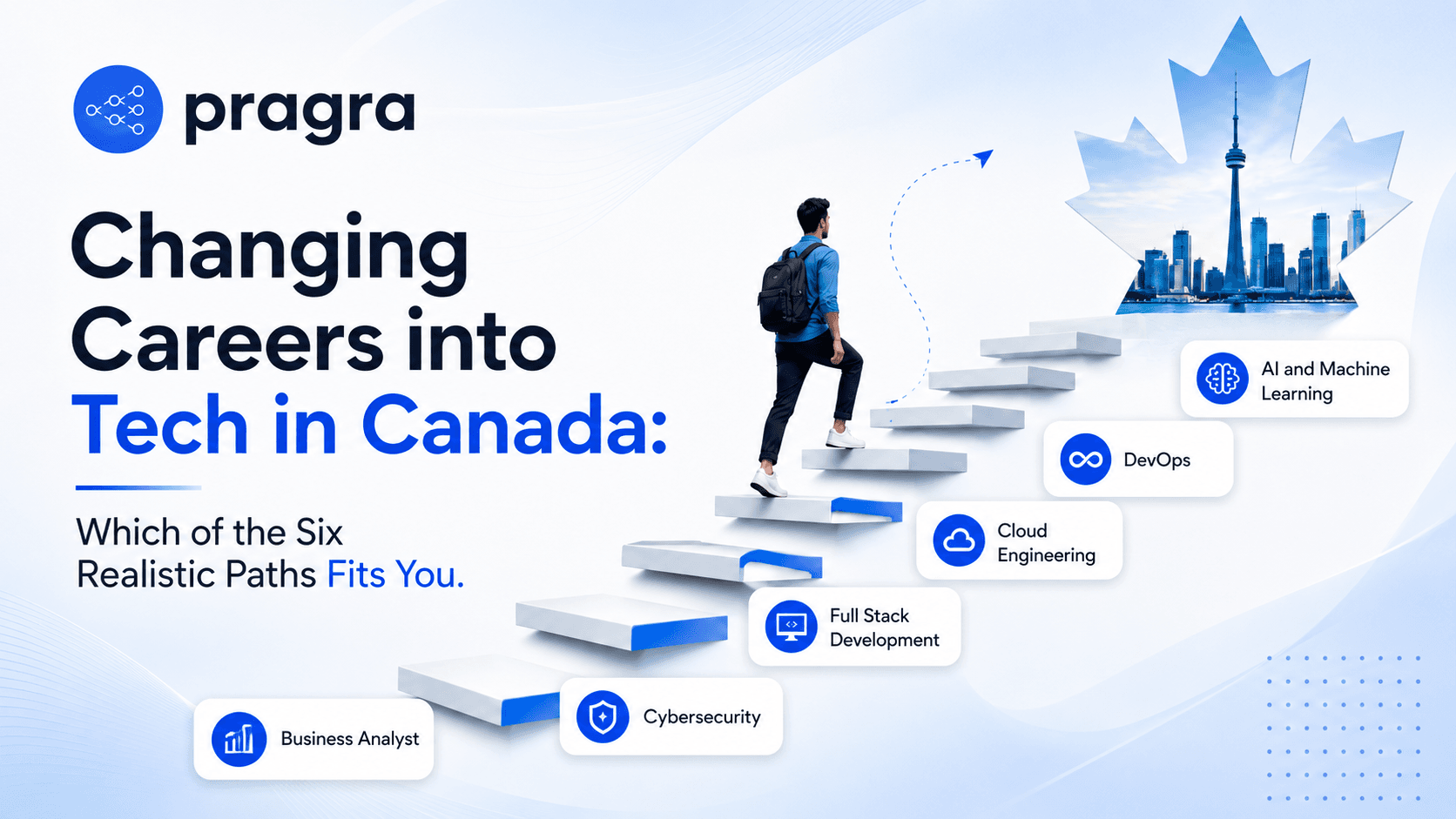
Changing Careers Into Tech in Canada: Which of the Six Realistic Paths Fits You
Most advice about changing careers into tech skips the only question that matters: which part of tech?
"Learn to code" is not a plan. Software development, cybersecurity, business analysis, cloud, DevOps, and machine learning are six different jobs with six different entry requirements, six different hiring processes, and — according to Government of Canada wage data — a spread of about CAD $23,000 a year between them at the median.
Choosing wrong costs you a year and several thousand dollars. Choosing well is mostly a matter of matching the path to what you already have, rather than to what sounds most exciting.
Here's the honest version of each, including who should not pick it.
First, the reality check
Two things worth knowing before you invest anything.
The Canadian market is competitive, not desperate. You'll read a lot of "massive shortage" marketing. For data scientists — one of the most hyped roles — the Canadian Occupational Projections System expects labour demand and supply to be broadly in line over 2024– 2033, with three-year job prospects rated Limited in Ontario and Quebec. That's balance, not scarcity. It doesn't mean don't switch. It means being merely qualified isn't enough; you need to be demonstrably better than the next applicant, which is a different goal and requires different preparation.
Your existing experience is an asset, not a liability. The single most common mistake career changers make is trying to erase their past and compete as a generic junior. Ten years in insurance operations makes you a far stronger business analyst candidate than a 22-year-old CS graduate. Warehouse and logistics experience makes you credible in supply chain tech. Nursing experience makes you valuable in health informatics. The paths below are ordered by how well they let you use what you already have.
Path 1 — Business Analyst
The most underrated entry point in Canadian tech.
What it is: You sit between business stakeholders and technical teams, work out what a system actually needs to do, document requirements, and keep delivery aligned with intent. Requirements workshops, user stories, process modelling, backlog management.
Canadian pay (NOC 21221): national median CAD $45.13/hour, range $30.67–$62.50 (Job Bank, updated November 2025). The lowest median of the six — but the highest floor. The narrow range means less downside risk than any other path here.
Who this is for: People with strong communication and organizational skills and real domain experience in any industry. Insurance, banking, healthcare admin, logistics, retail operations, project coordination, teaching — all transfer directly. No coding required.
Who should skip it: People who want deep technical work. If you find meetings and stakeholder management draining, you will not enjoy this job, regardless of what it pays.
Realistic timeline: roughly 3–6 months of training plus 3–6 months of job searching. These are estimates based on typical part-time study and Canadian hiring cycles, not guaranteed outcomes.
Why it works for career changers: business analysis exists in every industry, not just tech companies — so you can often move into a BA role at the kind of company you already understand. That's a much shorter jump than switching industry and function simultaneously. See the business analyst course.
Path 2 — Cybersecurity
The most credential-flexible technical path.
What it is: Two broad directions. Defensive/technical work — monitoring alerts, investigating incidents, testing systems for weaknesses. And governance work — risk registers, compliance frameworks, vendor assessments, policy.
Canadian pay (NOC 21220): national median CAD $49.52/hour, range $30.00–$72.12. Ontario's median runs above national at $51.28/hour, and British Columbia's high end reaches $108.17/hour — the widest top-end spread of any of the six, which tells you specialisation pays here.
Who this is for: Technically curious people who like investigation and pattern-finding. Also — and this is genuinely underexploited — anyone from audit, compliance, risk, finance, or regulated-industry operations. The GRC side of security is desperate for people who understand controls and documentation, and that's a skill you may already have.
Who should skip it: People who want to build things. Security is largely about protecting, monitoring, and documenting. It's meticulous work, and if you want to see something you made go live, you'll be happier in development.
Realistic timeline: roughly 4–8 months of training plus 4–8 months of job searching (estimates). Note that entry-level security hiring often favours people who already work in IT — an IT support or helpdesk stint is a common and legitimate stepping stone.
Why it has its own government classification: Statistics Canada gave cybersecurity analysts a dedicated NOC code (21220). Occupations get their own code when they become large and distinct enough to track separately — a structural signal about the field's permanence, not just a hiring trend. See the cyber security course.
Path 3 — Full Stack Development
The biggest job pool and the most established path for career changers.
What it is: Building applications end to end — user interfaces, server-side logic, databases, and the connections between them.
Canadian pay (NOC 21232): national median CAD $48.08/hour, range $30.00–$76.92. Worth knowing: Ottawa's median ($50.26/hour) is higher than Toronto's ($48.08), and British Columbia leads at $52.40. If you're geographically flexible while everyone else is fixated on Toronto, that's real leverage.
Who this is for: People who like building and can tolerate being bad at something for months before being good at it. Prior exposure to any kind of logic, systems, or problem- solving helps — trades, accounting, engineering, and even complex operational roles transfer better than people expect.
Who should skip it: People looking for the fastest route in. This is the deepest job pool, but it's also where the most self-taught candidates are competing. You need genuine technical ability, not just a certificate.
Realistic timeline: roughly 6–9 months of training plus 4–8 months of job searching (estimates). Longer than business analysis. Also, more portable — development skills transfer across industries and countries better than almost anything else here.
The progression that matters: you start classified as a software developer (NOC 21232, median $48.08/hour) and move toward software engineer (NOC 21231, median$56.49/hour) as your scope grows. That's roughly a CAD $17,000 median difference for a promotion, not a career change. See the Java full stack development program.
Path 4 — Cloud Engineering
Best if you already work in IT or infrastructure.
What it is: Designing, deploying, and managing systems on cloud platforms — compute, storage, networking, identity and access, monitoring, cost control.
Canadian pay: cloud roles have no dedicated NOC code. Using computer engineers (NOC 21311) as a reference band, the national median is CAD $52.50/hour, range $32.05–$78.85. Depending on your actual duties you might instead classify under information systems specialists (NOC 21222) or software engineers (NOC 21231). Our NOC classification guide explains how to work out which applies to you — it matters for both salary benchmarking and immigration.
Who this is for: People already in IT support, system administration, networking, or on- premise infrastructure. If that's you, this is probably your highest-return move: you're upgrading an existing skill set rather than starting from zero, and the timeline is much shorter.
Who should skip it: Complete beginners with no IT background. It's possible, but you'd be learning infrastructure concepts and cloud platforms simultaneously, which is a harder starting point than development or business analysis. Consider entering IT support first.
Realistic timeline: if you're already in IT, roughly 3–5 months plus a shorter search — internal moves are common. From zero, 8–12 months plus a full external search (estimates).
Certification note: cloud is one of the few areas where a vendor certification carries real, immediate weight with Canadian employers. See the Google Cloud engineering course.
Path 5 — DevOps
Not a first job. A very good second one.
What it is: The engineering practice of getting software from a developer's machine into production reliably and repeatedly — CI/CD pipelines, infrastructure as code, containers, monitoring, release automation.
Canadian pay: like cloud, no dedicated NOC. Automation- and code-heavy DevOps work often classifies under software engineers and designers (NOC 21231), median CAD $56.49/hour — the highest median in this entire comparison.
Who this is for: People with existing development or systems administration experience. DevOps sits on top of both. It's a combination skill, and combination skills are hard to acquire without one of the components already in place.
Who should skip it — and be honest with yourself here: complete beginners. You'll see DevOps at the top of salary charts and reasonably want to go straight there. Don't. Without development or infrastructure experience underneath, you'll struggle in interviews and struggle harder on the job. Route through development or cloud first, then add DevOps within 12–24 months.
Realistic timeline: from a development or sysadmin background, roughly 4–6 months. From zero, plan 18–24 months total including the prerequisite path (estimates).
Why it pays: DevOps engineers are scarce because the role requires two skill sets that usually live in different people. That scarcity is exactly why it isn't an entry point. See the DevOps program.
Path 6 — AI and Machine Learning
The most hyped. Not the highest-paying. Read carefully.
What it is: Building systems that learn from data — training and evaluating models, and increasingly, building applications on top of existing AI models.
Canadian pay (NOC 21211, data scientists): national median CAD $46.15/hour, range $30.00–$69.74. That is the fifth-highest of the six paths in this article. Sit with that for a moment, because it contradicts nearly everything you'll read about AI careers.
The engineering-oriented version of ML work usually classifies under software engineers and designers (NOC 21231) instead, at a median of $56.49/hour — roughly CAD $20,000 more per year. Same field, different classification, materially different pay.
Three things the marketing doesn't tell you:
- Job Bank notes NOC 21211 usually requires a university degree; research-oriented roles typically expect a master's or PhD.
- Roughly 36,600 people worked in the occupation in Canada as of 2023. It's a small profession.
- The national outlook is balanced supply and demand through 2033, with prospects rated Limited in Ontario and Quebec.
Who this is for: People with quantitative backgrounds — engineering, physics, statistics, economics, actuarial work — or existing developers adding ML. If you have a maths-heavy degree in an unrelated field, this is genuinely your strongest play, because the hardest part is already done.
Who should skip it: career changers with no technical or quantitative background choosing this purely because AI is in the news. You will be competing against people with computer science and statistics degrees for a small number of positions in a balanced market. Pick a path where your existing experience counts for something.
Realistic timeline: from a technical or quantitative background, roughly 6–9 months plus 4–8 months of searching. From zero, 18 months or more, and you should plan to enter through an adjacent role first (estimates).
The honest recommendation: target the engineering side rather than the analysis side. It pays more, it's less credential-bound, and a portfolio of deployed work is verifiable in a way that "I understand modelling" is not. See the AI and machine learning bootcamp.
The decision matrix
| Your background | Strongest fit | Second option | Avoid for now |
|---|---|---|---|
| Finance, insurance, audit, compliance | Business Analyst | Cybersecurity (GRC) | DevOps |
| Operations, logistics, project coordination | Business Analyst | Full Stack | AI/ML |
| Retail, hospitality, admin, customer service | Business Analyst | Full Stack | DevOps, AI/ML |
| IT support, helpdesk, sysadmin | Cloud | Cybersecurity | — |
| Existing developer | DevOps | AI/ML(engineering track) | — |
| Engineering, physics, maths, statistics degree | AI/ML | Full Stack | — |
| Teaching, healthcare admin, government | Business Analyst | Cybersecurity (GRC) | DevOps, AI/ML |
| Trades, manufacturing, technical hands-on | Full Stack | Cloud | AI/ML |
| Newcomer with foreign tech experience | Match to your prior discipline | Cloud (certification driven) | — |
"Avoid for now" doesn't mean never. It means these paths require prerequisites you don't currently have, and attempting them first is the most common way career changes fail. Take the shortest credible route in, then move laterally once you're inside — internal moves are dramatically easier than external ones.
Narrowed it to two and stuck? That's the right place to be, and it's the point where a conversation beats more research. Bring your work history, your province, and your timeline. Book a consultation →
Four rules that apply to every path
-
Your first tech job doesn't have to be your destination. Optimize for getting inside a company with a technology function. Internal moves in year two are far easier than external moves in year one.
-
Portfolio beats certificate, everywhere. Every one of these paths is judged on demonstrable work — a deployed application, a documented risk register, a real BRD, a working pipeline. A certificate proves attendance. Work proves capability.
-
Check regional data before you commit geographically. Ottawa pays developers more than Toronto. Saskatchewan and Alberta pay business analysts above the national median. British Columbia leads in both development and security. The assumption that you must be in Toronto costs people money.
-
Plan for 9–18 months, not 3. Training is the shorter half. The job search is the longer, harder half, and underestimating it is why people quit two months before it would have worked.
Frequently asked questions
Which tech career is easiest to get into in Canada without a degree?
Business analysis is generally the most accessible because it requires no coding and transfers directly from operations, finance, and coordination roles. Cybersecurity is the most accessible of the technical paths, since entry-level security hiring weights hands-on lab work and certifications heavily. Software development has the largest job pool and the most established hiring process for self-taught and bootcamp candidates.
Which tech career pays the most in Canada?
On Government of Canada Job Bank data updated November 2025, software engineers and designers (NOC 21231) have the highest national median at CAD $56.49 per hour, roughly $117,000 per year at full-time hours. DevOps and machine learning engineering roles frequently classify under this code. Notably, data scientists (NOC 21211) sit lower at CAD $46.15 per hour.
Is 35 or 40 too old to switch into tech in Canada?
No, and mid-career changers often have an advantage that younger candidates don't: domain expertise. Business analysis, GRC-focused cybersecurity, and industry-specific technology roles actively reward years of experience in insurance, healthcare, finance, or operations. Choose a path that uses that experience rather than one that ignores it.
How long does a tech career change actually take in Canada?
Realistically 9 to 18 months from starting training to a first offer, depending on the path and your starting point. Training typically takes 3 to 9 months; the job search commonly takes another 3 to 8. These are estimates based on typical study patterns and Canadian hiring cycles, not guaranteed outcomes.
Should I go straight into AI and machine learning since it's growing fastest?
Only if you have a technical or quantitative background. The Canadian outlook for data scientists is balanced supply and demand through 2033, the occupation usually requires a university degree, and it has a lower national median wage than software engineering, cloud engineering, and cybersecurity. Without a relevant foundation, you'd be competing against computer science and statistics graduates for a small number of roles.
Can I do DevOps as my first tech job?
It's not recommended. DevOps sits on top of both software development and systems administration, and employers hire for that combination. Enter through development or cloud infrastructure first and add DevOps within 12 to 24 months — which is also the faster route to the higher-paying classification.
Do I need to move to Toronto for a tech job in Canada?
No. Job Bank regional data shows Ottawa's median for software developers above Toronto's, British Columbia leading in both development and security wages, and Saskatchewan and Alberta paying business analysts above the national median. Geographic flexibility is an advantage, not a compromise.
Start with the path, not the course
The order matters. Pick the path that uses what you already have, verify what it pays where you live, then choose training that targets it specifically.
| Path | Program |
|---|---|
| Business Analyst | Business Analyst Course |
| Cybersecurity | Cyber Security Course |
| Full Stack Development | Java Full Stack Development |
| Cloud Engineering | Google Cloud Engineering |
| DevOps | DevOps Program |
| AI & Machine Learning | AI & Machine Learning Bootcamp |
For the wage data and classification detail behind every figure in this article, see our guide to NOC codes for tech jobs in Canada.
Building capability across a team rather than changing careers yourself? See corporate technology training.
Continue Reading
Explore more news and insights from Pragra