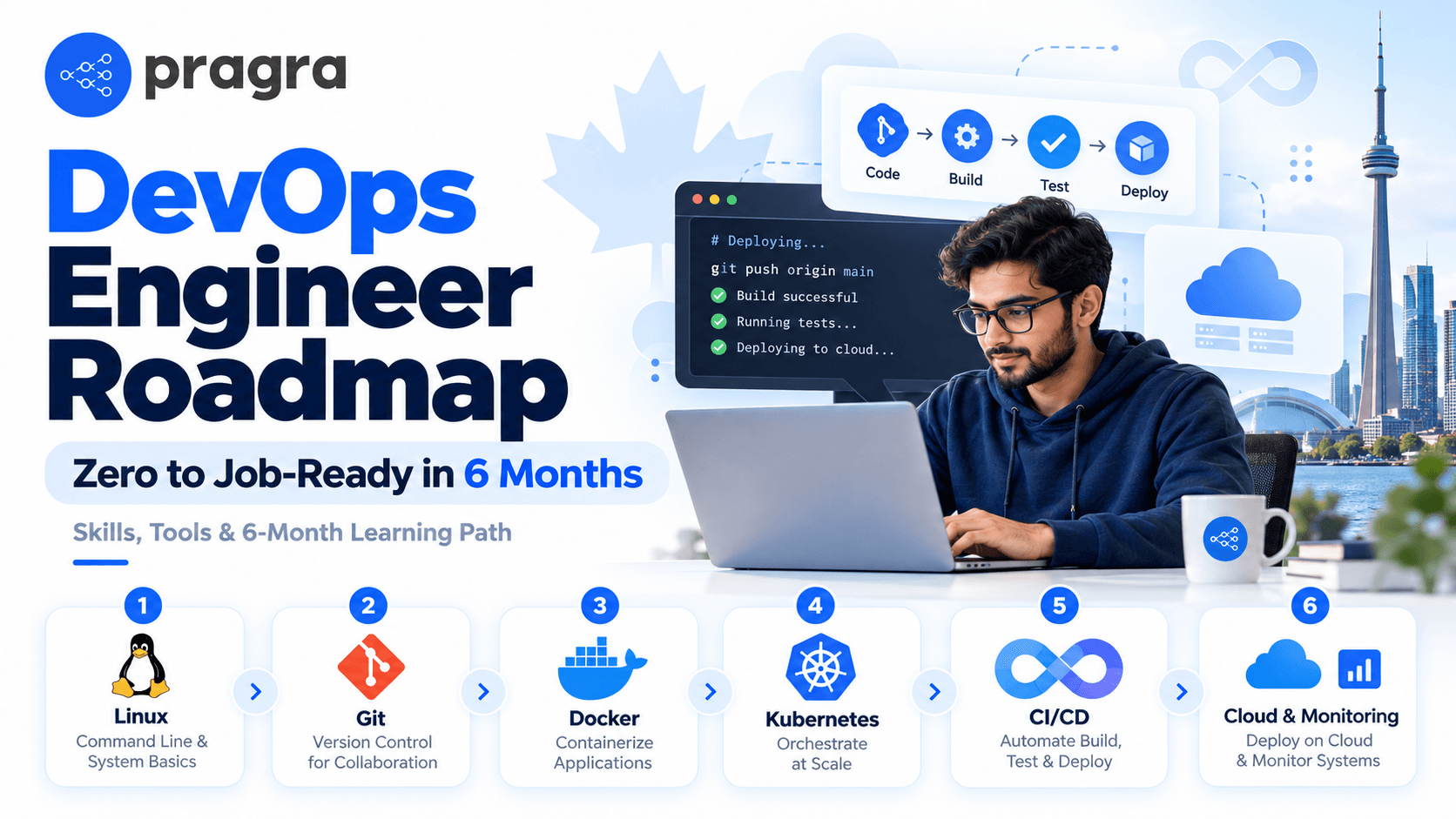
DevOps Engineer Roadmap Canada: Job-Ready in 6 Months (Canada Edition)
You can go from zero to job-ready as a DevOps engineer in about six months if you put in 15–20 focused hours a week and learn in the right order: Linux, Git, a cloud platform, CI/CD, Docker, Kubernetes, Terraform, then monitoring. Most people stall because they learn tools at random. This roadmap gives you one skill block per month, a project to prove each block, and the certifications and salary data that matter for the Canadian job market.
If you'd rather follow this path with instructors, live projects and job support, see Pragra's hands-on DevOps course in Canada. Otherwise, here's the full self-guided version.
What does a DevOps engineer actually do in Canada?
A DevOps engineer builds and runs the systems that take code from a developer's laptop to production safely and automatically. In practice that means:
- Building CI/CD pipelines so every code change is tested and deployed automatically
- Packaging applications in containers (Docker) and running them on Kubernetes
- Provisioning cloud infrastructure with code (Terraform) instead of clicking in a console
- Setting up monitoring and alerting so problems are caught before customers notice
- Working with developers, security and operations teams to ship faster with fewer outages
In Canada, the biggest employers of DevOps talent are banks and insurers, telecoms, government and public-sector IT, and SaaS companies in Toronto, Ottawa, Waterloo, Montréal, Calgary and Vancouver. The same skill set appears under several job titles: DevOps Engineer, Cloud Engineer, Platform Engineer, Build and Release Engineer and Site Reliability Engineer (SRE). Search for all five when you apply.
Is six months realistic?
Yes, for becoming job-ready. Getting hired is a separate step that often takes another two to four months of applications and interviews. Be realistic about the market: Canada's Job Bank rates the 2025–2027 outlook for software developers and programmers (NOC 21232) as "very limited" in the Toronto region. Entry-level tech roles are competitive. Candidates who stand out have working projects on GitHub, at least one cloud certification and a Canadian-format resume, not just course certificates.
Six months works best if you:
- Can commit 15–20 hours a week consistently
- Are comfortable using a computer beyond everyday tasks (installing software, editing files)
- Have some IT, support, QA or development background. That helps but isn't required
The 6-month DevOps roadmap at a glance
| Month | Focus | Core tools | Proof-of-skill project |
|---|---|---|---|
| 1 | Linux, networking and shell scripting | Ubuntu, Bash, SSH, DNS/HTTP basics | Automate server setup with a Bash script |
| 2 | Version control, Python and cloud basics | Git, GitHub, Python, AWS (EC2, S3, IAM, VPC) | Deploy a static site on AWS with a custom domain |
| 3 | CI/CD and containers | Jenkins or GitHub Actions, Docker, Docker Compose | Pipeline that tests, builds and deploys a Dockerized app |
| 4 | Container orchestration | Kubernetes, kubectl, Helm | Run a multi-service app on a Kubernetes cluster |
| 5 | Infrastructure as code and configuration | Terraform, Ansible | Provision the whole AWS environment with Terraform |
| 6 | Monitoring, security and job prep | Prometheus, Grafana, basic DevSecOps | Capstone: blue/green deployment with monitoring |
Month 1: Linux, networking and shell scripting
Almost every production server you'll touch runs Linux, so this is the foundation. Don't skip it to get to Kubernetes faster; weak Linux skills show up immediately in interviews.
Learn:
- File system navigation, permissions, users and groups
- Processes, services (systemd) and logs
- Package managers (apt, yum)
- Networking basics: IP addresses, ports, DNS, HTTP/HTTPS, SSH and firewalls
- Bash scripting: variables, loops, conditionals and cron jobs
Milestone: write a Bash script that sets up a fresh Ubuntu server: create users, install Nginx, configure the firewall and schedule a daily backup with cron.
Month 2: Git, Python and your first cloud platform
Git is how every team collaborates, and every pipeline you build later starts with a Git push. Learn branching, merging, pull requests and resolving conflicts.
Python is the most common scripting language in DevOps after Bash. You don't need to become a developer; you need to read code, write automation scripts and call APIs.
Pick one cloud and go deep. For the Canadian job market, AWS appears in the most DevOps postings, with Azure strong at banks and enterprises and Google Cloud growing. Start with AWS unless your target employer uses something else. Learn EC2, S3, IAM, VPC, security groups and load balancers.
Milestone: host a static website on S3 behind CloudFront with a custom domain and HTTPS, with all the code in a GitHub repo.
Month 3: CI/CD pipelines and Docker
This is where you start doing real DevOps work.
CI/CD (continuous integration and continuous delivery): learn Jenkins, because many Canadian enterprises and banks still run it, and GitHub Actions, which most startups and SaaS companies use. Build pipelines that run tests, build artifacts and deploy automatically.
Docker: learn to write Dockerfiles, build and tag images, manage volumes and networks, and run multi-container apps with Docker Compose.
Milestone: a pipeline that runs on every push, tests a small web app, builds a Docker image, pushes it to a registry and deploys it to an EC2 instance.
Month 4: Kubernetes
Kubernetes is the skill that most separates DevOps candidates. It's also the hardest month, so budget extra time.
Learn:
- Pods, Deployments, Services, ConfigMaps and Secrets
- Ingress and how traffic reaches your app
- Scaling, rolling updates and rollbacks
- Helm charts for packaging applications
- Managed Kubernetes (Amazon EKS or Google GKE)
Milestone: deploy a three-tier app (frontend, API, database) on Kubernetes, with rolling updates triggered by your CI/CD pipeline.
Month 5: Infrastructure as code with Terraform
Clicking around a cloud console doesn't scale and can't be reviewed. Terraform lets you define infrastructure in code, version it in Git and rebuild it in minutes.
Learn:
- Providers, resources, variables and outputs
- State files, remote state (S3 backend) and locking
- Modules for reusable infrastructure
- Ansible basics for configuring servers after they're created
Milestone: tear down everything you built by hand in months 2–4 and rebuild it with Terraform: VPC, subnets, security groups, EKS cluster and load balancer, from one terraform apply.
Month 6: Monitoring, security and getting hired
Monitoring: learn Prometheus for metrics and Grafana for dashboards, plus how to set alerts that mean something. Understand the difference between logs, metrics and traces.
Security basics (DevSecOps): secrets management, least-privilege IAM, image scanning in pipelines, and why you never commit credentials to Git.
Capstone project: combine everything into one production-style project, a blue/green deployment. Run two identical environments, deploy the new version to the idle one, run checks, then switch traffic with zero downtime. Add Grafana dashboards and alerts. This single project, documented well, is worth more in interviews than five course certificates.
Job prep: spend at least 30% of this month on your resume, LinkedIn, GitHub README files and mock interviews.
Certifications that matter to Canadian employers
Certifications won't replace projects, but they get your resume past recruiters and applicant-tracking filters. In order of value for a beginner:
- AWS Certified Solutions Architect – Associate. It's the most requested cloud certification in Canadian DevOps postings. Start with AWS Cloud Practitioner if you're completely new.
- Certified Kubernetes Administrator (CKA). It's hands-on and performance-based, so employers trust it.
- HashiCorp Terraform Associate. It's quick to earn and directly tied to infrastructure-as-code work.
If your target employers are Azure shops (common at banks and insurers), swap AWS for AZ-104 Azure Administrator. If you lean toward Google Cloud, look at Pragra's Google Cloud engineering course.
Portfolio projects that get interviews
Recruiters skim; hiring managers click. Each project should have a clear README with an architecture diagram, setup steps and what you learned. Build at least these four:
- Automated server provisioning: Bash plus Ansible
- CI/CD pipeline for a containerized app: GitHub Actions or Jenkins, Docker, AWS
- Kubernetes microservices deployment: EKS or GKE, Helm, autoscaling
- Capstone: Terraform-built infrastructure with a blue/green deployment and Grafana monitoring
DevOps engineer salary in Canada
DevOps is one of the better-paid entry points into tech in Canada:
- Government of Canada Job Bank (NOC 21231, DevOps engineer): national hourly wages range from $35.00 (low) to $56.49 (median) to $91.35 (high). That's roughly $73,000, $117,000 and $190,000 a year at 40 hours a week.
- Indeed Canada: the average DevOps engineer salary is $107,151 a year, based on 406 reported salaries (updated October 2026). Top-paying cities are Markham ($146,349), Ottawa ($129,337) and Calgary ($120,345).
Expect to start at the lower end of these ranges in your first role. Salaries rise quickly after two to three years once you've run production systems. For a city-by-city breakdown.
How to land your first DevOps job in Canada
- Use a Canadian-format resume: two pages maximum, no photo, no date of birth, achievements written with numbers ("cut deployment time from 40 minutes to 6").
- Apply for adjacent titles: Junior Cloud Engineer, Build and Release Engineer, Platform Support and Systems Administrator roles are realistic stepping stones.
- Target the right employers: banks, insurers, telecoms and government IT run large DevOps teams and hire steadily across Ontario, Quebec and Alberta.
- Network locally: DevOps and cloud meetups in Toronto, Ottawa, Calgary and Vancouver are where many referrals start.
- Show, don't tell: link your GitHub in the first line of your resume and LinkedIn headline.
If you're switching careers, our guide to changing careers into tech in Canada covers the bigger picture.
Self-study or a DevOps bootcamp?
You can follow this roadmap on your own with free and low-cost resources. Many people do. Self-study usually fails for three reasons: no one reviews your work, there are no real cloud environments to break, and motivation drops around Kubernetes in month 4.
A structured program fixes those three problems. Pragra's DevOps course with certification prep follows this same path: Linux, Git, Jenkins CI/CD, Docker, Kubernetes, Terraform and a cloud capstone with a blue/green deployment. It adds instructor-led live classes, hands-on projects and job assistance. You can also read what past learners say in our student success stories.
Frequently asked questions
Can I become a DevOps engineer in 6 months with no experience?
Yes, you can become job-ready in about six months with 15–20 hours of study a week, if you follow a structured order: Linux, Git, cloud, CI/CD, Docker, Kubernetes, Terraform and monitoring. Landing the first job can take another two to four months, so build projects and apply in parallel from month 5.
Do I need a computer science degree to become a DevOps engineer in Canada?
No. Canadian employers hiring DevOps engineers focus on hands-on skills, cloud certifications and portfolio projects. A degree helps with some large employers and immigration pathways, but many working DevOps engineers come from IT support, QA, system administration or bootcamps.
What is the average DevOps engineer salary in Canada?
Indeed Canada reports an average of $107,151 a year (October 2026). Job Bank data for NOC 21231 shows a national median of $56.49 an hour, about $117,000 a year full-time. Entry-level roles typically start at the lower end of the range.
Which certification should a beginner DevOps engineer get first?
Start with AWS Certified Solutions Architect – Associate (or AWS Cloud Practitioner if you're completely new to cloud). Then add Certified Kubernetes Administrator (CKA) and HashiCorp Terraform Associate. If your target employers use Azure, take AZ-104 instead of the AWS certification.
Should I learn AWS, Azure or Google Cloud for DevOps jobs in Canada?
AWS appears in the most Canadian DevOps job postings, so it's the safest first choice. Azure is common at banks, insurers and large enterprises, and Google Cloud is growing. Learn one platform deeply first; the concepts transfer to the others.
Is DevOps coding-heavy?
DevOps involves scripting more than application development. You need solid Bash and working Python to automate tasks, plus YAML and HCL (Terraform) for configuration. You don't need to build full applications, but you must be able to read and debug code.
Start your DevOps career
Pick your start date, block 15–20 hours a week in your calendar and begin with Month 1 today. If you want instructors, real cloud labs and job support along the way, book a free consultation for Pragra's DevOps course.
Continue Reading
Explore more news and insights from Pragra