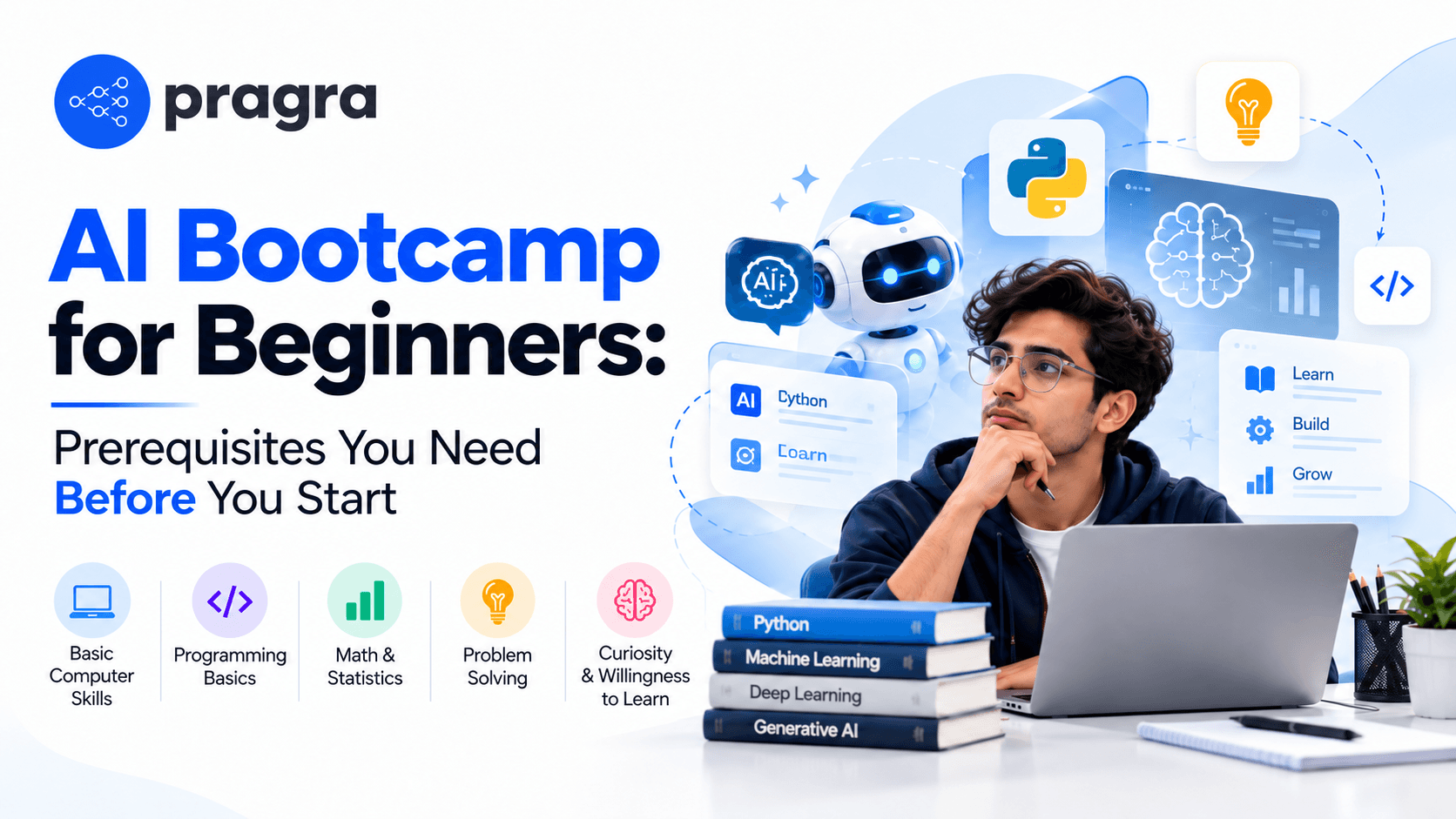
AI Bootcamp for Beginners: Prerequisites You Need Before You Start
What you need before an AI bootcamp for beginners
You don't need a computer science degree or any coding experience to join an AI bootcamp for beginners. To keep up, you do need five things: basic Python (or the time to learn it fast), high-school math, comfort working with data, a workable computer setup and protected practice time every week.
Most beginners who struggle in an AI program aren't defeated by AI itself. They fall behind because they're learning Python syntax, refreshing algebra and meeting machine learning for the first time, all in the same week. Get the first two out of the way before day one and the bootcamp becomes about AI instead of catching up.
This guide covers exactly what to have in place, what you can safely skip, a quick readiness check and a four-week prep plan. It's written for people in Canada weighing a move into AI: recent grads, professionals switching fields and newcomers building their skills for the Canadian job market.
Do you need coding experience before an AI bootcamp?
No, not to enrol in a program built for beginners. A good beginner AI bootcamp teaches Python from scratch. Pragra's AI & Machine Learning Bootcamp, for example, gives Python for data science its own module before you build your first model.
Here's the part most course pages skip. In an intensive program, Python is taught quickly and then used immediately. Within a few sessions you're loading datasets and training models, so the language stops being the lesson and becomes the tool.
If your first-ever loop happens in week two, you'll be decoding syntax while the class is thinking about models. Treat coding as "not required, strongly recommended." Even 15 to 20 hours of beginner Python before you start means class time goes to machine learning, not missing brackets.
Prerequisite 1: Basic Python
Python is the working language of machine learning. The libraries you'll use in almost any AI bootcamp (NumPy, Pandas, scikit-learn, TensorFlow and PyTorch) are all Python. You don't need to be a developer; you need to read and write short scripts without stalling on every line.
Before day one, aim to be comfortable with:
- Variables and data types: numbers, text (strings) and true/false values
- Lists and dictionaries, and looping over them
- if/else logic and for loops
- Writing and calling a simple function
- Importing a library and using one of its functions
- Reading an error message and searching for what it means
You can skip, for now, object-oriented programming, algorithms and data structures, and web frameworks. Those matter for software engineering roles, not for your first machine learning model.
Prerequisite 2: The math you actually need
High-school algebra and basic statistics are enough to start. A well-built beginner program then teaches the linear algebra, calculus and probability machine learning relies on; in Pragra's curriculum that's Module 2, before any models.
What matters is knowing where each topic shows up, so it doesn't feel abstract when it arrives:
| Math area | Where it shows up in machine learning | What to know before day one |
|---|---|---|
| Algebra (functions, equations, slope) | Every model maps inputs to outputs; linear regression is literally a line | Solve for x; read y = mx + b and explain what m means |
| Basic statistics (mean, median, standard deviation) | Exploring data, spotting outliers, judging model results | Calculate and interpret average and spread; read a histogram |
| Probability | Classification outputs, model confidence, language models | What "80% likely" means; the idea of "how likely is B, given A" |
| Linear algebra (vectors, matrices) | A dataset is a matrix; neural networks multiply matrices | Nothing formal; know a matrix is a grid of numbers |
| Calculus (derivatives) | How models learn, through gradient descent | Nothing formal; know a derivative measures how fast something changes |
The real prerequisite isn't math talent. It's math patience: being willing to sit with a formula until you can say in plain words what it does.
Prerequisite 3: Comfort working with data
Machine learning is mostly data work. Before a model learns anything, someone has to load the data, find the gaps, fix the formats and decide what each column means. Beginners who've never looked closely at a messy spreadsheet find this the most surprising part of the job.
You're in good shape if you can:
- Open a CSV file in Excel or Google Sheets and explain what each row and column represents
- Sort, filter and spot missing or obviously wrong values
- Build a simple chart and say what it shows
- Use a basic formula or pivot table to summarize a column
If you've done reporting, budgeting or analysis in any job, you already have a head start here. Many career changers underrate this; it transfers directly.
Prerequisite 4: A workable computer and setup
You don't need a powerful gaming PC. A Windows, Mac or Linux laptop and a reliable internet connection are the baseline for most beginner AI programs, Pragra's included.
A few practical checks save a lot of frustration in week one:
- Memory: 8 GB of RAM works for beginner projects; 16 GB is more comfortable once datasets grow.
- Install rights: you'll install Python, libraries and code editors. Many employer-issued laptops block this, so use a personal machine if you can.
- Cloud notebooks: heavier deep learning work can run in a browser through Google Colab, whose free tier means you don't need to buy a graphics card.
- Live-class logistics: a webcam, a headset and ideally a second screen, so you can watch the instructor and code at the same time.
- Time zone: if you're joining live online classes from Vancouver, Calgary or Halifax, convert the schedule to your local time before you commit.
Prerequisite 5: Time and learning habits
This is the prerequisite people underestimate most. Class hours teach you concepts; practice hours are where you actually learn to build. Pragra's bootcamp, for example, runs 60 hours of instruction and asks you to complete 10 portfolio projects, which happens mostly outside class.
A useful rule of thumb: plan at least one hour of practice for every hour of class. If you're working full-time, block fixed evenings or weekend mornings now, before the program starts, rather than hoping time appears.
The habits that predict success matter more than raw ability:
- Debugging patience: much of your early time goes to fixing errors. That's normal, not a sign you're failing.
- Asking early: the learners who struggle quietly for a week fall furthest behind.
- Consistency over intensity: five focused hours spread across a week beat one exhausted Sunday.
- Saving your work publicly: a GitHub account from day one turns class projects into a portfolio employers can see.
What you don't need before an AI bootcamp
Plenty of capable people talk themselves out of starting because of requirements that don't exist. For a beginner program, you do not need:
- A computer science degree. Beginner bootcamps assume none.
- University-level calculus or linear algebra. You'll learn the parts machine learning uses, in context.
- Prior machine learning experience. That's what the program is for.
- An expensive GPU. Cloud notebooks cover the heavy lifting while you learn.
- To be a "math person" or a certain age. Neither appears on any beginner program's prerequisite list; steady practice matters far more than background.
What you do need is honesty with yourself about the time. That's the one gap no amount of enthusiasm closes.
Are you ready? A 2-minute self-check
Tick each statement that's true for you today:
- I can write a short Python script with a loop and an if statement.
- I can write a simple function and call it.
- I can solve a basic equation and explain what the slope of a line means.
- I can explain the difference between an average and a median.
- I can open a CSV in a spreadsheet, filter it and make a chart.
- I have a laptop where I'm allowed to install software.
- I've blocked regular weekly time for practice outside class.
- I'm comfortable searching an error message and trying fixes on my own.
A four-week prep plan
For most beginners, four weeks at about five hours a week is enough:
- Weeks 1–2: Python. Variables, lists, dictionaries, if/else, loops and a simple function. Aim for the 15 to 20 hours that keep week two from turning into a syntax class.
- Week 3: Math refresh. Solve for x, read y = mx + b, and be able to explain an average, a median and a spread.
- Week 4: One small project on real data. Open a CSV, filter it, fix obvious gaps and make one chart you can explain in a sentence.
How to judge a beginner AI bootcamp in Canada
The right beginner program is honest about where you start and specific about where you'll finish. Before you enrol anywhere, ask these seven questions:
- Does it teach Python and the math from scratch, or quietly assume them? Look for dedicated foundation modules, not a one-line "basic Python recommended."
- How many instruction hours, and how many projects? Hours tell you the pace; projects tell you how much you'll actually build.
- Live online, in person or self-paced? Live classes add accountability, self-paced adds flexibility. Check class times in your own time zone.
- What happens when you fall behind? Ask about mentors, recordings and how quickly questions get answered.
- Is the certificate tied to assessed work? One that requires finished projects and a passing score means more than one for attendance.
- What does career support actually include? Ask for specifics, such as résumé reviews, mock interviews and portfolio feedback.
- What's the total cost, and does any training funding apply? Ask directly; eligibility varies by program and province.
A beginner bootcamp gives you the foundation, a portfolio and a clear sense of which path fits you. For many learners, the realistic next step is applying AI and data skills in their current field or an entry-level data role, then building toward specialized AI positions.
For a closer look at one of those paths, see our guide on how to become a machine learning engineer in Canada.
Where Pragra's AI & Machine Learning Bootcamp fits
Pragra's AI and machine learning bootcamp for beginners is designed for people with basic computer skills and no prior machine learning experience. Here's how it answers the questions above:
| What to check | Pragra's AI & ML Bootcamp |
|---|---|
| Foundations taught from scratch | Module 1 introduces AI and ML, Module 2 covers the math, Module 3 teaches Python for data science, all before your first model |
| Instruction and projects | 60 hours across 10 modules, with 10 hands-on portfolio projects |
| What you'll cover | Supervised and unsupervised learning, deep learning, model evaluation, NLP, computer vision and model deployment |
| Format | Live online from anywhere in Canada or the US, in person at the Mississauga campus, or self-paced; same curriculum and certificate |
| Certificate | Requires all 10 modules, all 10 projects and a final assessment score of 70% or higher |
If you ticked six or more boxes in the self-check, you're ready to start.
Next step: review the full AI & ML curriculum, or book a free consultation to talk through your background and which format suits your schedule.
Frequently asked questions
Can I join an AI bootcamp with no coding experience?
Yes. Beginner AI bootcamps, including Pragra's, teach Python from the ground up. Still, 15 to 20 hours of free Python practice before you start makes a real difference, because the language gets used right away once machine learning begins.
How much math do I need for an AI bootcamp for beginners?
High-school algebra and basic statistics. You'll learn the linear algebra, calculus and probability that machine learning uses during the program. What helps most is being comfortable reading a formula and explaining what it does in plain words.
How long should I prepare before starting?
For most beginners, four weeks at about five hours a week is enough: two weeks of Python, one week of math refresh and one small project on real data.
Can I do an AI bootcamp while working full-time?
Yes, if you protect the time. Pick a format that fits your schedule, block fixed weekly practice slots in advance, and plan roughly one hour of practice for every hour of class.
Do I need a powerful computer for machine learning?
No. A laptop with 8 GB of RAM handles beginner projects, and 16 GB is more comfortable. Free cloud notebooks such as Google Colab cover heavier deep learning work.
Will a beginner AI bootcamp get me a job in Canada?
No bootcamp can honestly guarantee a job. It gives you skills, a portfolio and direction. Roles like data scientist typically ask for a degree and experience, according to Job Bank, so use the bootcamp to build a foundation and target roles that match your background.
Continue Reading
Explore more news and insights from Pragra