Java Full Stack Developer Course – Live Online Bootcamp with Spring Boot, Microservices & React
Our Java full stack developer course takes you from zero coding experience to building and deploying production-style applications with Java, Spring Boot, microservices, React, Docker and Kubernetes. Run as a live, instructor-led bootcamp for learners in Canada and the US, it pairs every module with hands-on labs and ends with a full-stack capstone you can show employers. In the US, software developers earn a median $135,980 a year (May 2025), with 10% projected job growth from 2025 to 2035 (BLS).
- Live online bootcamp
- Beginner
- Canada & US
Java Full Stack Course Overview
This program covers the full journey of a modern Java developer: operating-system and cloud fundamentals, CORE JAVA and OOP, the Spring ecosystem, REST APIs, microservices, a React single page frontend, and containerised deployment on Kubernetes - plus the data structures, algorithms, and design patterns that come up in technical interviews. You'll practise each layer on real projects and finish with a full-stack capstone.
Key Features
- 24/7 support
- Hands-on projects
- Flexible schedule
- Industry-recognized certification
- Job assistance
- Lifetime access to course material
Skills You Learn in This Full Stack Java Course
- Build console-based Java applications using OOP principles
- Write unit tests with Junit and Hamcrest
- Use Git for version control and Jenkins for CI/CD pipelines
- Develop Spring Boot applications with REST APIs, Spring Data JPA, and Spring Security with JWT
- Build microservices using Spring Cloud (Config Server, Eureka, Gateway, Hystrix, Sleuth, Zipkin)
- Implement event-driven services with RabbitMQ and Kafka
- Containerize applications with Docker and deploy on Kubernetes
- Build dynamic single-page applications (SPAs) with React and Redux
- And more...
About This Course
Skills You Learn in This Full Stack Java Course
- Foundations: OS, Linux & Cloud Get comfortable with operating-system concepts, Linux, shell scripting, and AWS cloud basics - the ground every developer stands on.
- Core Java & OOP Master the JVM, object-oriented design, collections, multithreading, functional interfaces, streams, I/O, and database programming.
- Build & Testing Manage builds with Maven and write reliable unit tests with JUnit and Hamcrest.
- Version Control & CI/CD Use Git branching workflows and GitLab CI, and automate builds and deployments with Jenkins pipelines.
- Spring Framework & Spring Boot Apply IoC, dependency injection, and AOP; build Spring Boot apps with Spring Data JPA and Spring Security with JWT.
- REST APIs & Web Build REST controllers with Swagger and HATEOAS, plus servlets, MVC, Thymeleaf, and reactive WebFlux.
- Microservices with Spring Cloud Design microservices with Config Server, Eureka, API Gateway, Hystrix, Sleuth, and Zipkin, and add event-driven messaging with RabbitMQ and Kafka.
- Frontend with React Build dynamic single-page applications with HTML, CSS, Bootstrap, modern JavaScript, React, and Redux.
- Containerization & Kubernetes Containerise applications with Docker and Docker Compose, and deploy and scale them on Kubernetes.
- DSA, Design Patterns & Agile Strengthen problem-solving with data structures and algorithms, apply common design patterns, and work in Agile with Jira and Confluence.
- Career Preparation Get resume support, mock technical interviews, and portfolio guidance built around developer hiring in Canada and the US.
Tools & Technologies Covered
- Language & Build: Core Java | Maven | JUnit | Hamcrest
- Backend: Spring Framework | Spring Boot | Spring Data JPA | Spring Security (JWT) | Spring Cloud
- Microservices & Messaging: Eureka | API Gateway | Hystrix | Sleuth | Zipkin | RabbitMQ | Kafka
- Frontend: HTML | CSS | Bootstrap | JavaScript | React | Redux
- DevOps & Data: Git | Jenkins | Docker | Kubernetes | MySQL | MongoDB | Jira
Java Full Stack Bootcamp: Duration & Format
| Category | Details |
|---|---|
| Duration | 39 Hours |
| Primary Focus | End-to-end Java full-stack development (backend → frontend → deployment) |
| Key Technologies | Core Java, Maven, Junit, Git, Jenkins, Spring Framework, Spring Boot, Spring Cloud, Microservices, Docker, Kubernetes, React, Jira |
| Databases | MySQL, MongoDB |
| Cloud Platforms | AWS, GCP, PCF |
| Delivery Mode | Hands-on projects, term projects, capstone project |
Core Pillars of the Curriculum
| Pillar | Focus Areas |
|---|---|
| Foundations | OS concepts, Linux, AWS cloud fundamentals, shell scripting |
| Core Java | JVM/JRE/JDK, OOPs, collections, multithreading, functional interfaces, streams, I/O, database programming |
| Build & Testing | Maven, Junit, Hamcrest, unit testing |
| Version Control & CI/CD | Git, GitLab CI, Jenkins pipelines |
| Spring Ecosystem | Spring Framework (IoC, DI, AOP), Spring Boot, Spring Data JPA, Spring Security, JWT, Spring Cloud |
| REST APIs & Web | Servlets, MVC, Thymeleaf, REST controllers, Swagger, HATEOAS, WebFlux |
| Frontend | HTML, CSS, Bootstrap, JavaScript (ES2015/16), React, Redux |
| Microservices | Spring Cloud Config, Eureka, API Gateway, Hystrix, Sleuth, Zipkin, RabbitMQ, Kafka, OAuth2.0 |
| Containerization & Orchestration | Docker, Docker Compose, Kubernetes |
| DevOps & Agile | Jira, Confluence, Agile methodologies |
| DSA & Design Patterns | Arrays, LinkedList, Stacks, Queues, Maps, Binary Search, Merge/Quick Sort, Graph/Tree, Singleton, Factory, Observer, etc. |
Learning Journey Map
OS Fundamentals → Linux & AWS Cloud
          ↓
Core Java (OOPs, Collections, Multithreading, Streams)
          ↓
Maven & Junit (Unit Testing)
          ↓
Git (Version Control) → Jenkins (CI/CD)
          ↓
Spring Framework & Spring Boot
          ↓
REST APIs, Swagger, Spring Security & JWT
          ↓
Spring Cloud & Microservices (Eureka, Gateway, Hystrix, Sleuth, Kafka)
          ↓
Docker & Containerization → Kubernetes Deployments
          ↓
React Frontend (HTML, CSS, JS, Redux)
          ↓
DevOps & Agile (Jira, Confluence)
          ↓
Data Structures & Algorithms → Design Patterns
          ↓
Capstone Project (Hiring Platform with Spring + React on Kubernetes)
Join Our Thriving Community
By enrolling today, you'll also get to join our exclusive live online community classroom to learn alongside thousands of students, alumni, mentors, TAs and Instructors.
These are just a few of the words students use to describe the Pragra community which is also one of the biggest and most active developer communities.
Here's the Truth
Most courses teach you the basics and that's it. They show you how to get started. They get you to memorize a bunch of syntax. But then you have no idea where to go from there or the steps to take so that you can build projects on your own.
This Course is Different
This comprehensive project-based course is different. Not only will you learn all of the modern skills needed, but you will also build 10+ real-world projects to add to your portfolio.
The curriculum is very hands-on. We take you step-by-step from start to finish of becoming a professional developer.
We start from the very beginning where you'll learn the fundamentals and programming basics. But unlike most tutorials, we don't stop there.
We'll then dive into advanced topics and different career fields so you can get real-life practice and be ready for the real world.
Is This Full Stack Java Course Suitable for Beginners?
Yes. You do not need a computer science degree or prior coding experience.
Java Full Stack Developer Course Syllabus (17 Modules)
From Core Java and the Spring ecosystem through microservices, React, and Kubernetes, ending in a full-stack capstone.
Self-Paced Course vs Live Java Full Stack Bootcamp
Both formats use the same curriculum and the same projects. Self-paced learners move on their own timeline and receive a certificate of completion. The live bootcamp adds a fixed schedule, a dedicated mentor, reviewed projects, and career support: résumé, LinkedIn, mock interviews, and job assistance.
Self-Paced Learning
Learn at your own pace
- Lifetime access to course material
- 24/7 support
- Self-paced learning
- Certificate of completion
- Hands-on projects
- Community access
Online Bootcamp
Instructor-led live classes
- Live online classes
- Hands-on projects
- Dedicated mentor
- Job assistance
- Industry-recognized certification
- Lifetime access to course material
Not sure which option is right for you? Both formats include the same comprehensive curriculum and lifetime access. The Bootcamp option adds live instructor sessions and dedicated mentorship for faster learning and career support.
Java Full Stack vs MERN / JavaScript Full Stack
Both paths lead to full stack developer jobs. The difference is where they lead: Java full stack is the default in banks, insurers, telecoms and government; MERN dominates startups and product companies.
| Factor | Java Full Stack (this course) | MERN / JavaScript Full Stack |
|---|---|---|
| Backend | Java + Spring Boot | Node.js + Express |
| Frontend | React | React |
| Database | MySQL (relational) + MongoDB | MongoDB (document) |
| Languages to learn | Two: Java and JavaScript | One: JavaScript everywhere |
| Learning curve | Steeper at first (static typing, OOP, Spring) | Faster to a first working app |
| Typical employers | Banks, insurance, telecom, government, large enterprise | Startups, SaaS, agencies, product companies |
| Strength | Large-scale, secure, transactional systems; microservices | Rapid prototyping, real-time apps |
| Job stability | Long-lived enterprise codebases; steady demand | Fast-moving; frameworks change often |
| Best for you if | You want enterprise or backend-heavy roles in Canada or the US | You want to ship products quickly or join a startup |
Self-Paced Course vs Live Online Bootcamp
Same curriculum. The live bootcamp adds a schedule, a mentor, and career support.
| Factor | Self-Paced Course | Online Bootcamp |
|---|---|---|
| Time to job-ready | Your own timeline | A fixed cohort; length is published with the batch |
| Structure | Fixed curriculum, your pace | Fixed curriculum, fixed schedule |
| Live instruction | None | Yes, live classes each week |
| Mentor / code review | 24/7 support | Dedicated mentor |
| Portfolio projects | Hands-on projects + capstone | Hands-on projects + capstone, reviewed |
| Accountability | Low | High: cohort, deadlines |
| Career support | Not included | Resume, LinkedIn, mock interviews, job assistance |
| Certificate | Certificate of completion | Industry-recognized certification |
| Best for | Working professionals who need flexibility | Career changers who want a structured route |
Career Opportunities in Full Stack Java Development
Full stack Java skills are among the most durable in enterprise tech — Java and Spring power backends across banking, insurance, government, and large-scale systems. Because this course covers the complete Java stack plus React and Kubernetes, you can target Java backend, frontend, and full-stack roles. In the US, software developers earn a median $135,980 a year (May 2025), with 10% projected job growth from 2025 to 2035 (BLS).
Career Path
Your journey from beginner to expert
Junior / Associate Developer - entry
Full Stack Java Developer
Senior Full Stack Java Developer
Lead Developer / Software Engineer
Why Choose a Career in Full Stack Java Development?
- Full-stack Java developers are flexible hires - able to work across backend, frontend, or both
- Java and Spring remain enterprise workhorses with deep, durable demand in banking, insurance, and government
- Clear progression: Developer -> Senior Developer -> Tech Lead, Architect, or Engineering Manager
- A strong project portfolio can outweigh the lack of a CS degree at the interview stage
- Skills stack: adding cloud, DevOps, or AI on top of full-stack opens even more roles
Why Choose the Pragra Full Stack Java Developer Bootcamp?
Watching tutorials teaches you syntax, not how to ship software. This program is built around building - you'll construct real applications end to end, so you finish able to design, build, and deploy a full-stack system yourself.
What Makes This Course Different
- True end-to-end coverage: core Java through microservices, React, and Kubernetes in one program
- A capstone hiring-platform application built with Spring and React and deployed on Kubernetes
- Interview-focused data structures, algorithms, and design-patterns modules most bootcamps skip
- Real DevOps exposure (Git, Jenkins, Docker) so you understand how your code reaches production
- Career support: resume, LinkedIn, and mock technical interviews for developer hiring
Success Stories
Real graduates, real results
Our graduates are now working at top tech companies


Sarah Chen
Software Engineer
Previous Role
Retail Manager
Salary Increase
+178%
Now at
“I went from retail to tech in just 6 months. Now earning 3x my previous salary!”

Michael Rodriguez
DevOps Engineer
Previous Role
IT Support
Salary Increase
+145%
Now at
Amazon
“Doubled my salary and now working at my dream company. Pragra made it happen!”

Priya Patel
Data Scientist
Previous Role
Financial Analyst
Salary Increase
+115%
Now at
Microsoft
“Transitioned from finance to data science. Best career move ever!”
So there's no reason it can't be you too.
They come from all different backgrounds, ages, and experiences. Many even started as complete beginners.
Full Stack Java Developer Certification
Bootcamp learners receive an industry-recognized Pragra certification. Self-paced learners receive a certificate of completion. It can be verified online and added to LinkedIn. Employers weigh your GitHub portfolio more than the certificate, so the projects matter most.
Industry Recognition
Certificate recognized by top tech companies and hiring managers
Portfolio Ready
Add to your LinkedIn profile and resume to showcase your expertise
Lifetime Validity
Your certificate never expires and can be verified online
Exam Requirements: Complete all modules, submit the hands-on projects, and score at least 70% on the final assessment.
Certificate of Completion
Pragra
This is to certify that the above named has successfully completed the course requirements
Explore our courses
Browse the full catalog and find the next program that fits your goals
Programming
This intensive 39‑hour program takes Java developers beyond fundamentals, covering advanced OOP, concurrency, JDBC, Servlets, JSP, and Spring. Hands‑on labs build scalable, secure backend applications ready for enterprise use. Graduates will confidently tackle real‑world role‑ready projects.
AI & ML
Learn machine learning and AI by building real projects — from Python and data analysis to deep learning, NLP, computer vision and model deployment. Join live online classes from anywhere in Canada or the US, or learn in person at our Mississauga campus. Designed for beginners with basic computer skills; no prior ML experience needed.
Business Analysis
Business analysts are the bridge between business needs and technical delivery, and demand stays strong across North America. In the US, employment of computer systems analysts is projected to grow 9% from 2024 to 2034, faster than the avg for all occupations, with about 34,200 openings each year. In Canada, business systems analysts earn a national median near CAD $45.13/hour (~$94,000/yr) . This hands-on business analyst course builds the Agile, requirements, and AI skills employers hire for.
Programming
Dive into the fundamentals of Java with our 39‑hour Core Java Fundamentals course. Designed for all learners, this Level 1 class builds the foundations you need for the full Java bootcamp, covering core language features, data structures, and object‑oriented design. Prepare to advance to Advanced Java and Spring Frameworks with confidence.
Cybersecurity
Cybersecurity is one of North America's most resilient career markets. In the United States, employment of information security analysts is projected to grow 29% from 2024 to 2034 — much faster than the average for all occupations — with about 16,000 openings each year (U.S. Bureau of Labor Statistics). Demand across Canada's major hubs is following the same upward trend. This hands-on cyber security course gives you the offensive, defensive, and compliance skills employers actually hire for.
DevOps
DevOps engineering is one of the highest-paid, most in-demand tech skill sets in NA. This hands-on DevOps course takes you from Linux and Git fundamentals to building CI/CD pipelines, containerizing with Docker, orchestrating with Kubernetes, and automating infrastructure with Terraform. In the US, software developers (the closest BLS match for DevOps engineers) earn a median of USD $133,080 with 15% projected growth from 2024 to 2034. No prior DevOps experience required.
Cloud Computing
Cloud skills are among the most in-demand in tech, and GCP is one of the three major clouds enterprises hire for. This hands-on GCP course takes you from cloud fundamentals to deploying and managing real workloads on GCP: Compute Engine, GKE, App Engine, Cloud Storage, BigQuery, VPC networking, and IAM security, and prepares you for certification. In the US, computer network architects earn a median of USD $130,390 with 12% projected growth from 2024 to 2034 . No prior cloud experience required.
Programming
Transform into a job-ready backend developer with hands-on training in Spring Boot, REST APIs, microservices, and JPA integration. Build scalable enterprise applications and gain real-world project experience to land Java or Backend Developer roles.
Java Full Stack Articles
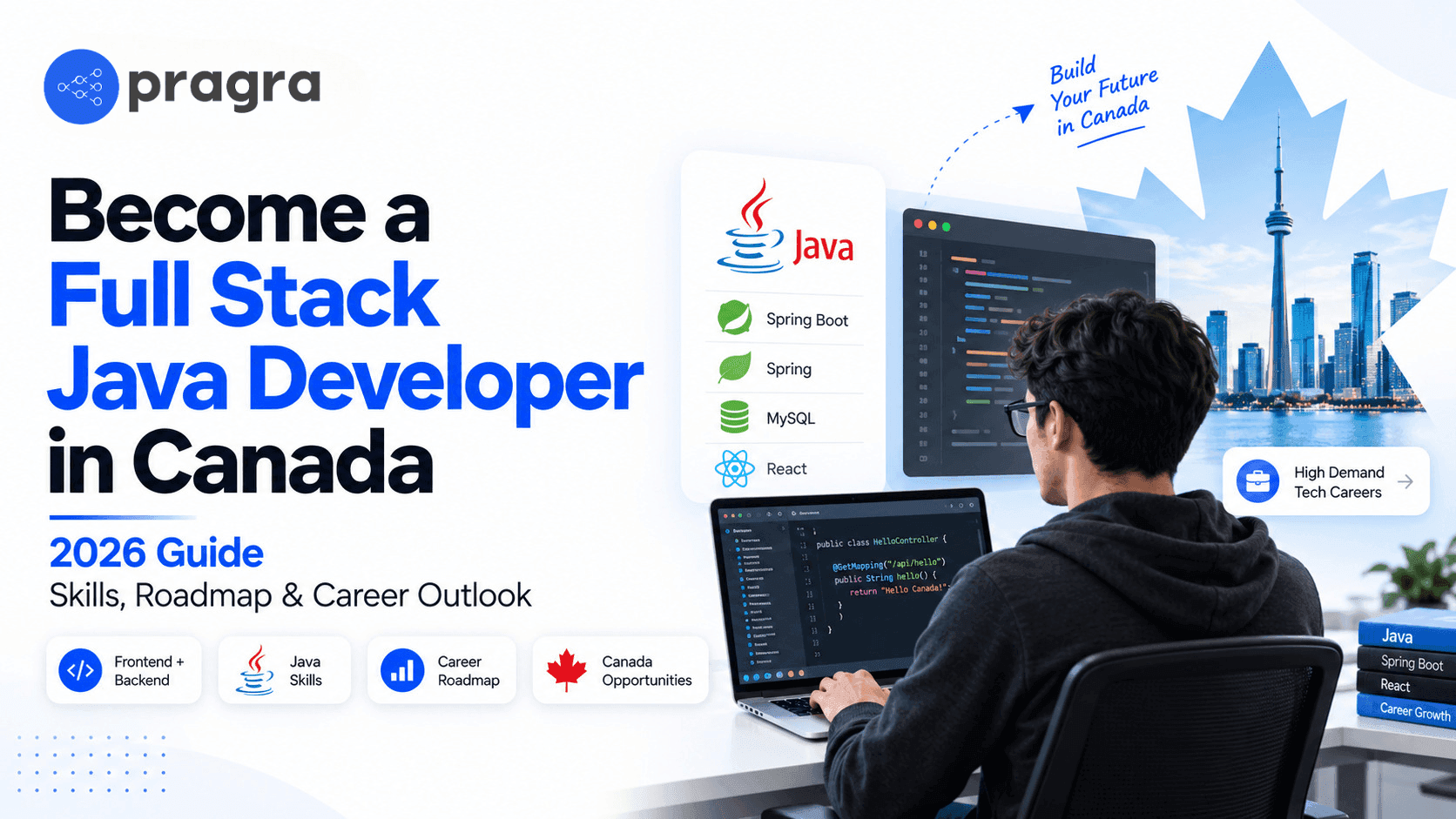
Java full stack remains a powerful career path, combining enterprise reliability, modern cloud skills, and strong long-term demand across Canada.

Explore the Java Full Stack Developer career path and what you need to know to become one.

Discover how Pragra's Full Stack Java Course prepares you for success in 2025 and how you can get started today.
Start Your Full Stack Java Developer Career Today
Build practical, in-demand Java development skills, ship real applications, and prepare for one of the most durable careers in enterprise tech. Not sure if full stack Java is the right path? Book a free consultation and we'll map your fastest route into a developer role.
Java Full Stack Course FAQs
Yes. The course starts with operating-system basics, Linux and Core Java before it touches Spring or React, so you do not need a computer science degree. Each module builds on the previous one, and labs follow every lesson. If you already code, you can move faster through the early modules.
Yes. Bootcamp learners receive an industry-recognized Pragra certification; self-paced learners receive a certificate of completion. To earn it, you complete all modules, submit the hands-on projects and score at least 70% on the final assessment. The certificate can be verified online and added to LinkedIn. Employers weigh your GitHub portfolio more than any certificate, so the projects matter most.
The live bootcamp follows a fixed cohort schedule, with live classes, labs, and a capstone. The exact number of weeks and hours per week is published with each cohort. Self-paced learners move through the same curriculum on their own timeline. Plan extra practice on Spring and microservices, which are the hardest modules for most learners and the ones interviewers test most.
No. You need a computer, a stable internet connection and time to practise. The first modules cover programming fundamentals in Java from scratch. Learners with some coding background, in any language, usually find the Spring and microservices modules easier. Not sure where you stand? Book a free consultation and an advisor will assess your starting point.
It is a Java full stack course. The backend is built in Java with Spring Boot, Spring Data JPA, Spring Security and Spring Cloud microservices. The frontend uses React, which is written in JavaScript, so you learn enough modern JavaScript to build single-page apps. If you want Node.js on the backend instead, a MERN course is the better fit.
Yes. Classes run live online, scheduled for Eastern and Pacific time zones, so learners anywhere in Canada or the US can join. Career support, résumé reviews and mock interviews are built around hiring practices in both countries. Tuition is listed in CAD and USD, and the course content and certificate are the same in either country.
We do not guarantee a job, and a placement percentage is not published until it is calculated for a defined group of graduates. Graduates who finish the capstone, keep a public GitHub and apply consistently do best. Career support includes résumé and LinkedIn reviews, mock interviews and job assistance.
Yes. Most learners work full time, so live classes are scheduled on weekday evenings and weekend mornings in Eastern Time. All sessions are recorded, so you can catch up if you miss a class. Ask an advisor for the exact days and times of the next batch.
Refund terms depend on the format and how much of the course has been delivered. The exact window and any proration are not published on this page yet. Ask an advisor for the current policy before you enroll, and get the terms in writing.
Any Windows, Mac or Linux laptop from the last five years will work. We recommend at least 8 GB of RAM (16 GB is better for running Docker and Kubernetes locally), a modern quad-core processor and 20 GB of free disk space. You will install free tools: JDK 17 or 21, IntelliJ IDEA Community or VS Code, Git, Maven, MySQL and Docker Desktop.
The course uses a current Java LTS release, Java 17 or 21, and Spring Boot 3, the versions employers run in production. Spring Boot 3 requires Java 17 or later, so you learn current syntax and APIs, not legacy code. We also cover Spring Security 6 with JWT and Spring Cloud for microservices.
React is the most widely used frontend library in job postings and pairs cleanly with a Spring Boot REST backend. Its component model is also easier for beginners to learn first. Angular is common in some enterprise teams, and once you understand React, components, state and API calls, picking up Angular on the job takes weeks, not months.
Yes. The course is fully online, so you can join from anywhere, provided you can attend live classes in Eastern or Pacific time. Tuition can be paid in CAD or USD. Career support focuses on the Canadian and US job markets. If you plan to study in Canada on a study permit, note this is a non-credential course and does not qualify for one.